How to Verify Your Eclipse Glasses
Forget the complicated tests. The most reliable way to ensure your glasses are safe is simpler than you think.
Buy Direct from a Verified Manufacturer
The only way to be certain your eclipse glasses are safe is to purchase them directly from a manufacturer on our verified list—either from their own website, their official Amazon store, or another authorized sales channel they control.
If you can't trace your glasses directly back to a verified manufacturer, you can't be sure what you have.
View Verified Manufacturers"I Bought from an Authorized Reseller"
We frequently hear from people who say they purchased from an "authorized reseller" or "official distributor" of a verified manufacturer. Here's the problem:
Most verified manufacturers don't have authorized resellers. They sell direct—through their own website, their own Amazon store, or their own sales channels. Major brands are protective of their reputation and trademarks.
Yes, people buy in bulk and resell. That happens. But buying from a bulk purchaser who resells is not the same as buying from an "authorized reseller." When you buy through an intermediary, you're trusting that:
• They actually purchased from who they claim
• The product wasn't switched, mixed, or tampered with
• The storage and handling didn't damage the product
• They're not selling counterfeits alongside genuine products
What EU Certification Really Means
If you're buying eclipse glasses in Europe, there are some important realities about EU PPE certification that affect what's available and what you should be suspicious of.
Every Design Requires Its Own Certificate
In the past, if a solar filter film was tested and certified, a manufacturer could print different artwork on glasses using that film under the same certificate. That is no longer the case in the EU.
Under current EU PPE regulations, every change to the glasses—including artwork changes—requires a new EU Type Examination Certificate from a Notified Body. This process takes approximately 6 months and has significant costs.
What This Means for Buyers
Be suspicious of sellers offering many different "styles" or designs. Each style would require its own certificate. Legitimate EU-certified manufacturers typically offer a limited range of designs because each one represents months of certification work and significant investment.
Companies wanting custom branded glasses for promotional giveaways often don't realize that custom artwork requires a completely new certification process. When someone hands you branded eclipse glasses at an event, those glasses should still show evidence of meeting PPE Category 2 requirements with proper CE marking and Notified Body number.
Language Requirements
EU regulations require that safety information and instructions be provided in the official language(s) of the country where the product is sold:
- Germany — German language required
- France — French language required
- Spain — Spanish language required
- Italy — Italian language required
- And so on for each EU member state...
Legitimate manufacturers selling across multiple EU countries will have glasses with multiple languages. For example, glasses intended for broad EU distribution might have 4 or more languages on them.
The UK Situation
The United Kingdom is no longer part of the EU, and currently, the regulatory situation is different. At present, Amazon UK and the UK market in general appear to have fewer restrictions on eclipse glasses sales.
What's happening: Leftover USA stock from previous eclipses is being sold into the UK market. Some of this is perfectly good product from verified manufacturers. Some of it... isn't.
The challenge for UK buyers is that without the EU's PPE Category 2 requirements acting as a filter, there's less regulatory protection against non-compliant products. This makes it even more important to buy direct from verified manufacturers rather than unknown sellers clearing old inventory.
The Certificate Fraud Problem
There's a sophisticated scam you need to know about: sellers who have real certificates but ship counterfeit products.
Here's how it works:
1. A reseller buys a legitimate bulk order (500–1,000 units)
from a verified manufacturer
2. They request copies of the ISO test certificate and EU PPE2
documentation
3. They advertise using those authentic certificates
4. They ship counterfeit glasses that were never tested
The certificates they show you are genuine. The test reports are real. But the glasses you receive are not the glasses that were tested. They might look similar. They might even have the same printing. But they didn't come from the certified production line.
This is why "buy direct" is so important. When you buy from the manufacturer, the certificate actually applies to what you're receiving. When you buy from a third party waving certificates around, you have no way to verify the glasses in your hand are what was tested.
What to Look For
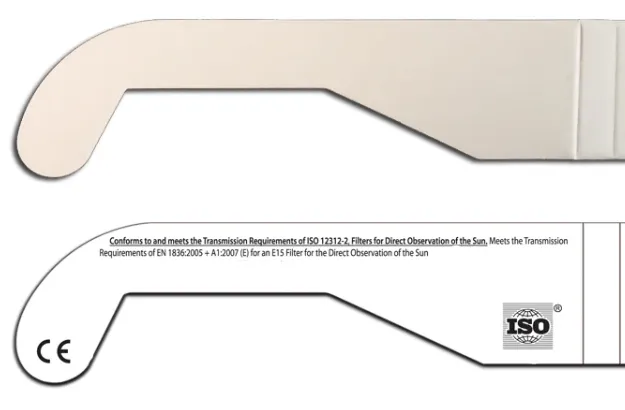
Even when buying from a verified source, it's good practice to inspect your glasses. Here's what genuine ISO 12312-2 compliant glasses should have:
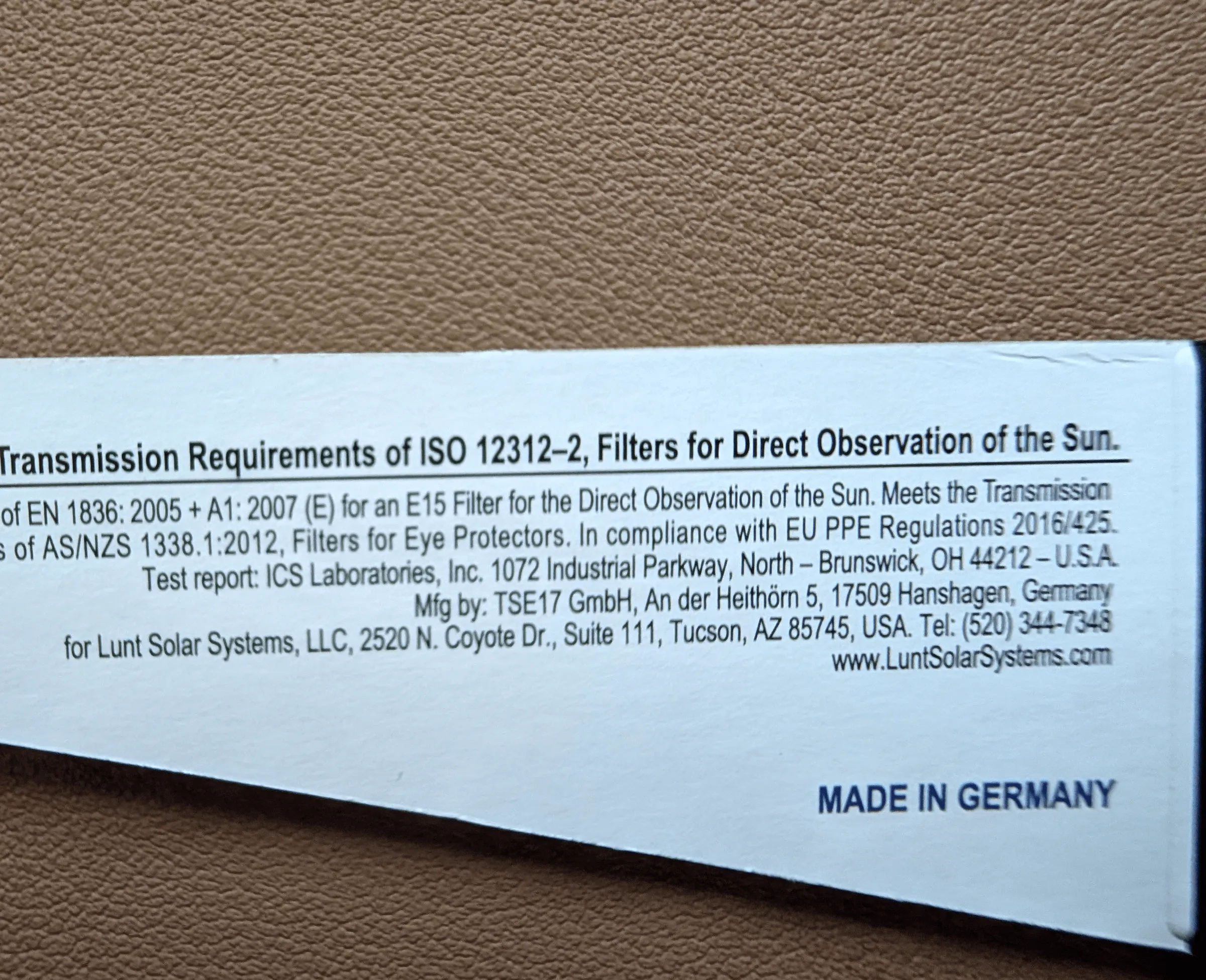
Complete Manufacturer Information
Name and address of the manufacturer clearly printed. You should be able to look them up and verify they exist.
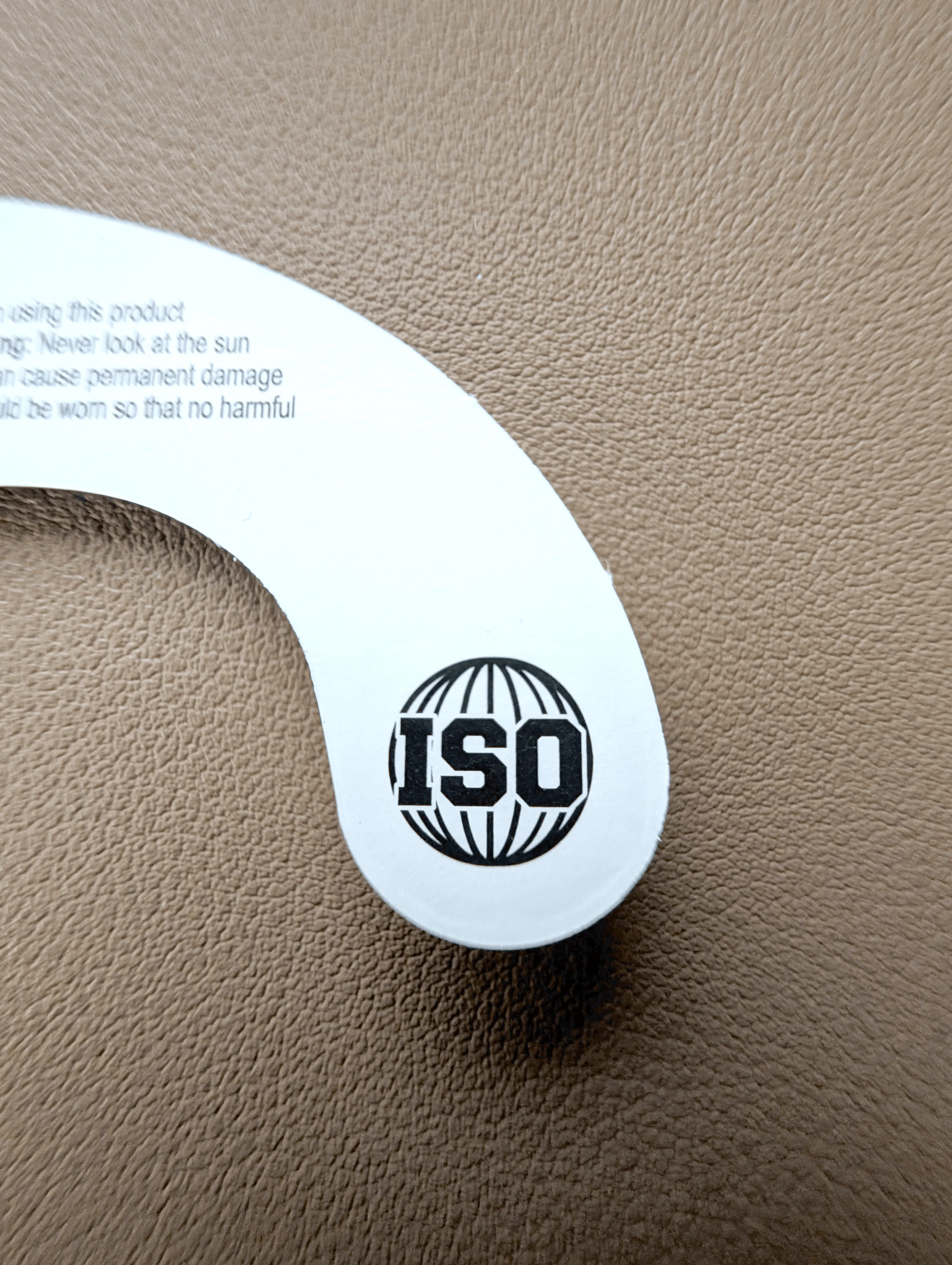
ISO 12312-2 Reference
The standard reference "ISO 12312-2" printed on the glasses or packaging. Note: This alone doesn't prove compliance, but its absence is a red flag.
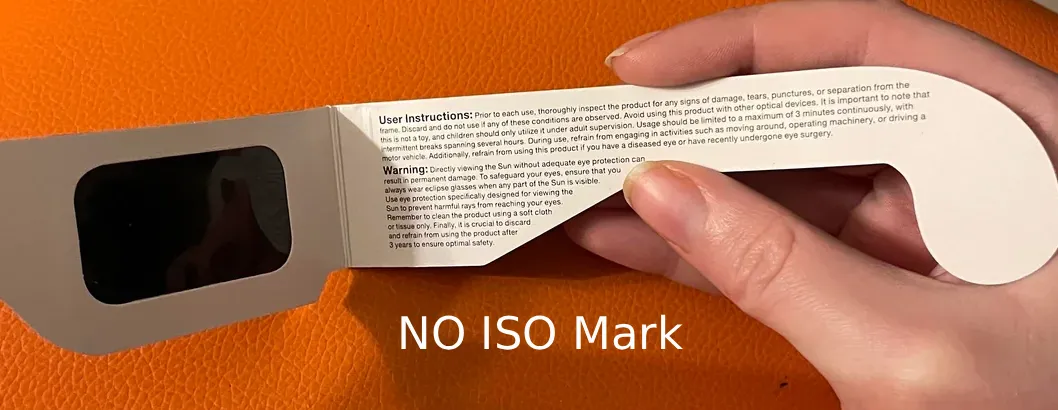
Missing or Vague Manufacturer
No manufacturer name, just a brand name, or a generic address like "Made in China" with no specific company information.
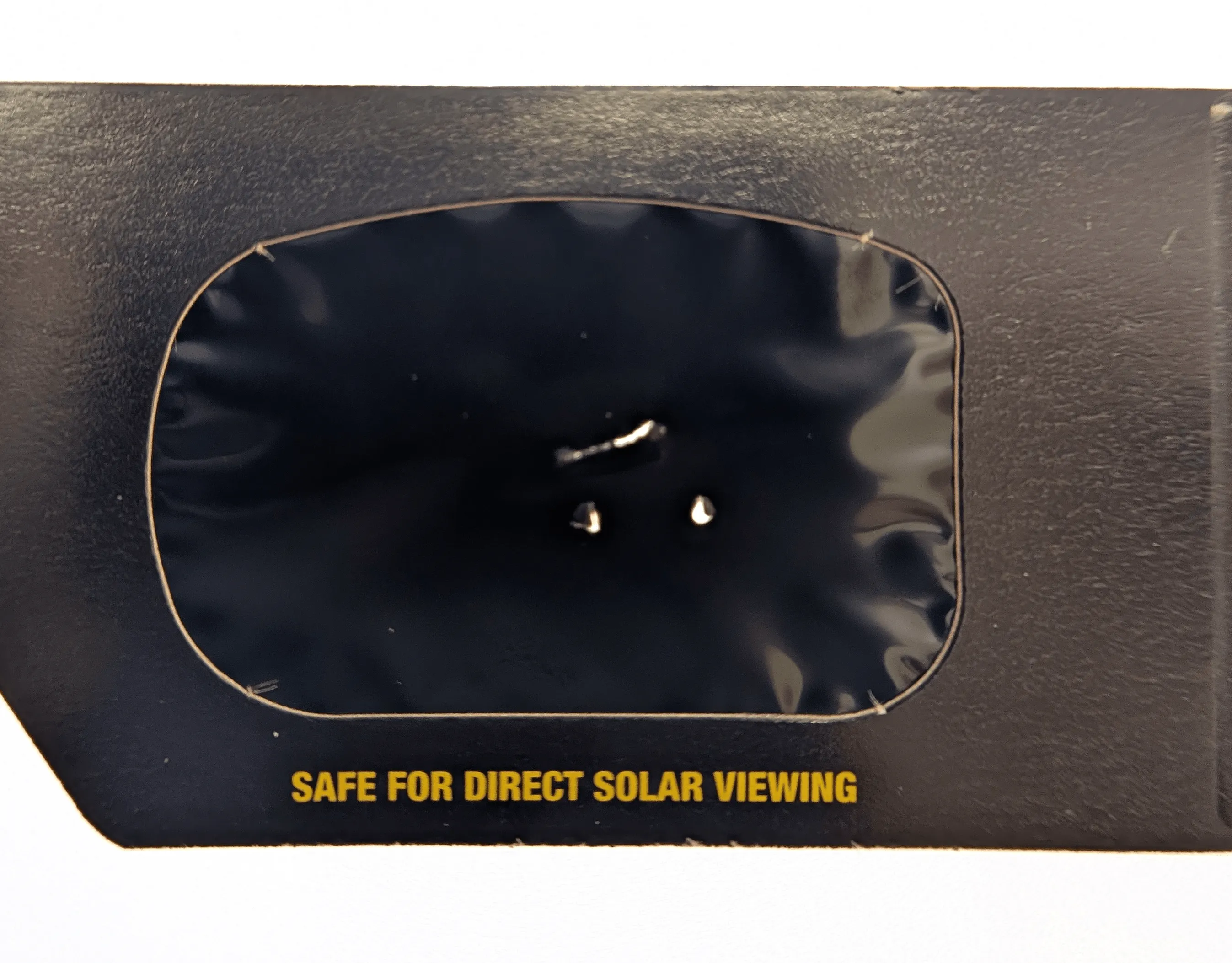
Scratched or Damaged
Any scratches, punctures, or peeling on the filter surface. Damage can create dangerous pathways for unfiltered light.
Red Flags to Watch For
Be suspicious of any of the following. Any one of these should make you question whether you have a genuine, safe product:
- Price too good to be true Genuine ISO 12312-2 compliant glasses cost money to manufacture and test. If you're seeing prices under $1 per pair retail, be very skeptical.
- Seller offering many different styles or designs In the EU, each design requires its own certification (6+ months, significant cost). A seller with dozens of "styles" is unlikely to have proper certification for all of them.
- Claims of "ISO Certified" or "ISO Approved" ISO does not certify or approve products. Any product making this claim demonstrates the seller doesn't understand (or is lying about) the standard.
- Claims to be an "authorized reseller" of a major brand Major brands are protective of their trademarks and reputation. Most sell direct and don't authorize resellers. Check the manufacturer's website to verify.
- No way to verify the manufacturer If you can't find the manufacturer's website, phone number, or physical address with a simple search, that's a problem.
- Seller won't provide documentation Legitimate sellers should be able to provide test reports or direct you to the manufacturer's certification documentation.
- Generic marketplace sellers Random sellers on Amazon, eBay, or other marketplaces who aren't the manufacturer themselves. The manufacturer's official store is the only safe bet.
- Glasses that look different from manufacturer's images Compare what you received to photos on the manufacturer's official website. Counterfeits often have subtle differences in printing, color, or construction.
- Wrong language for your country (EU buyers) In the EU, safety information must be in your country's official language. English-only glasses sold in Germany or France may not be properly certified for that market.
- Third-party seller prominently displaying certificates Ironically, a reseller who makes a big show of having "official certificates" may be using legitimate documents to sell counterfeit products. The certificate is real—but it doesn't mean the glasses they ship are what was tested.
Why "Home Tests" Don't Work
You may have read advice like "look at a bright light" or "you shouldn't be able to see anything except the sun." These tests are unreliable and potentially dangerous.
The problem: A filter can appear dark enough while still transmitting dangerous levels of infrared radiation that you can't see. It can also have uniformity issues—safe in some areas, dangerous in others.
The only reliable test is laboratory spectrophotometry across the full wavelength range. You can't do this at home. That's why buying from verified manufacturers is so important—the testing has already been done.
The Safe Approach: 3 Simple Steps
- Check our verified list Find a manufacturer on our approved list. These are manufacturers whose products have been verified to meet ALL ISO 12312-2 requirements.
- Buy direct from the manufacturer Purchase from the manufacturer's own website or their official Amazon/marketplace store. Not a third-party reseller, not a bulk purchaser who's reselling.
- Inspect when they arrive Check that the labeling matches what you expected, the filters are undamaged, and the packaging hasn't been tampered with. If anything seems off, contact the manufacturer directly.
Already Bought Glasses and Not Sure?
If you already have eclipse glasses and you're not certain they're safe, here's what to do:
- Check if the manufacturer is on our verified list
- If not, try to find test documentation from the manufacturer
- When in doubt, don't risk your eyesight—buy new ones from a verified source
- The cost of new glasses is trivial compared to permanent vision damage
Your eyes don't get a second chance. If there's any doubt about your glasses, replace them. It's not worth the risk.
Find Verified Manufacturers